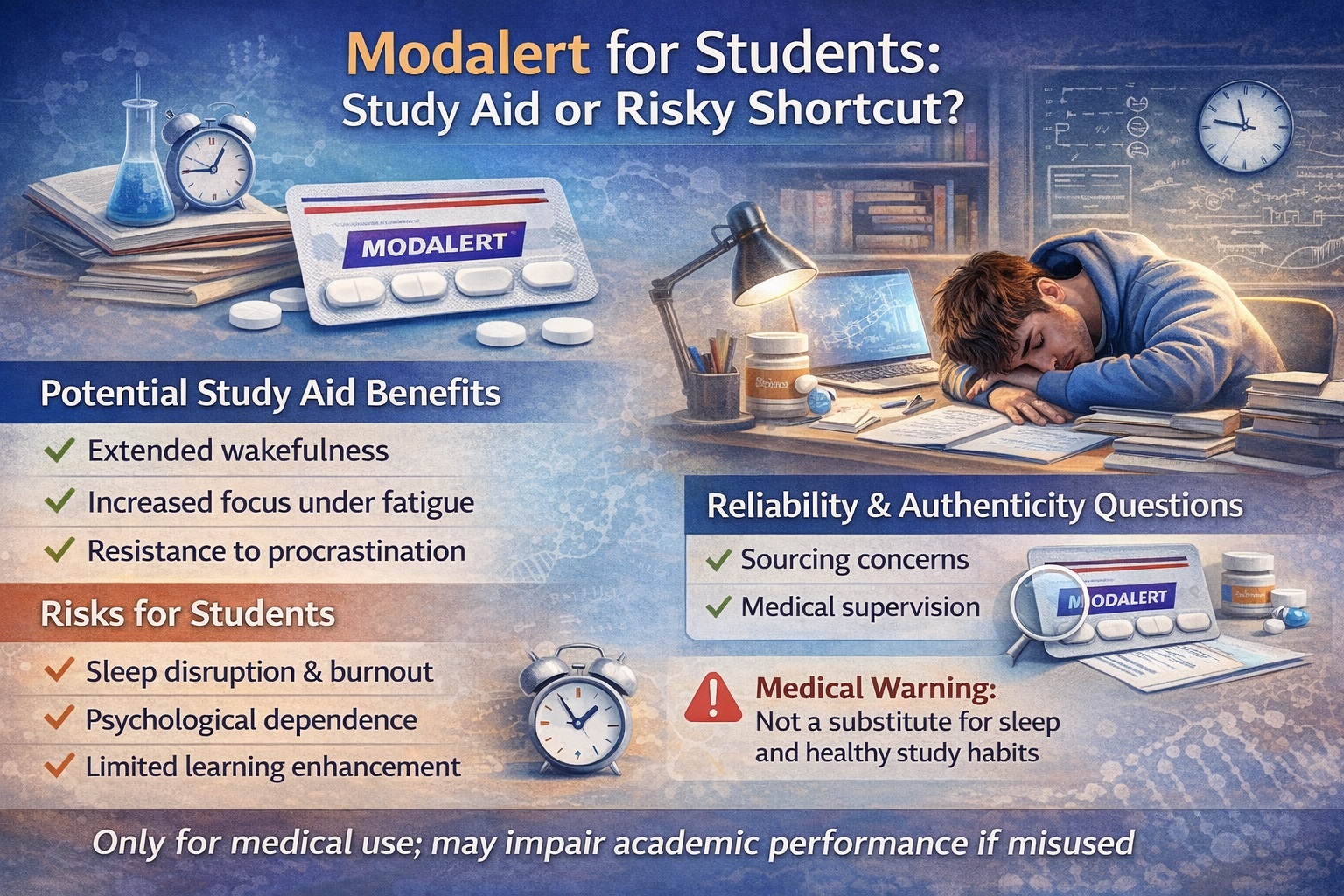
In competitive academic environments, students are increasingly exposed to discussions about cognitive enhancers. Among these, Modalert is frequently mentioned as a way to stay awake longer, study more efficiently, and push through demanding schedules. But does Modalert truly function as a study aid—or does it represent a risky shortcut with overlooked consequences?
This article examines Modalert use among students through scientific evidence, real-world patterns, and medical caution.
What Is Modalert and Why Do Students Use It?
Modalert is a branded formulation of modafinil, a prescription wakefulness-promoting agent approved for sleep-related disorders such as narcolepsy and shift-work sleep disorder.
Among students, Modalert is often used off-label to combat fatigue during exam preparation, long study sessions, or overnight coursework. Unlike caffeine, modafinil does not act as a classic stimulant but instead alters neurotransmitter balance to promote alertness and sustained attention.
The FDA describes modafinil as increasing extracellular dopamine by inhibiting dopamine reuptake, without the intense stimulation associated with amphetamines (FDA):
https://www.accessdata.fda.gov/drugsatfda_docs/label/2010/020717s020lbl.pdf
How Modalert May Help Students Academically
Sustained Wakefulness and Focus
In clinical environments, physicians often observe that modafinil improves vigilance and reduces performance decline caused by sleep deprivation. For students pulling long study hours, this can translate into fewer attention lapses.
Controlled trials show improved reaction time, alertness, and task persistence under fatigue (PubMed):
https://pubmed.ncbi.nlm.nih.gov/11823757/
This suggests Modalert may help students maintain study performance rather than enhance intelligence.
Reduced Mental Fatigue
Many student users report that Modalert makes repetitive or dense material easier to tolerate. This aligns with research showing improved endurance on monotonous cognitive tasks, especially when baseline fatigue is present.
User-reported Experiences frequently emphasize “staying mentally present” rather than feeling stimulated or euphoric.
What Modalert Does Not Do for Studying
Despite its reputation, Modalert is often misunderstood.
Research consistently shows that modafinil does not reliably improve:
- Creativity
- Learning speed
- Long-term memory consolidation
- Motivation or interest in tasks
A comprehensive NIH review concluded that cognitive benefits in healthy individuals are modest and task-dependent (NIH):
https://www.ncbi.nlm.nih.gov/pmc/articles/PMC2654794/
For students, this means Modalert may help endurance, not deeper understanding.
The Risks of Using Modalert as a Study Shortcut
Sleep Disruption and Academic Burnout
One of the most common student mistakes is using Modalert to replace sleep. While alertness may improve short-term, disrupted sleep cycles impair memory consolidation and learning over time.
Medical literature strongly emphasizes that sleep is critical for encoding and retaining new information (NIH):
https://www.ncbi.nlm.nih.gov/books/NBK526132/
Using Modalert repeatedly without adequate rest may undermine academic performance rather than support it.
Psychological Dependence
Although modafinil has lower abuse potential than amphetamines, some students develop a psychological reliance, believing they cannot study effectively without it.
This pattern is frequently contrasted with stimulant medications like Adderall, which carry higher dependency risks but also stronger motivational effects.
Is Modalert Safe for Students?
From a safety standpoint, modafinil is generally well tolerated when used under medical supervision. Common side effects include:
- Headache
- Appetite suppression
- Insomnia
- Anxiety or restlessness
Serious adverse reactions are rare but documented, including severe skin reactions (EMA):
https://www.ema.europa.eu/en/documents/assessment-report/modafinil-epar-assessment-report_en.pdf
Students with anxiety disorders, cardiovascular conditions, or sleep disorders should be especially cautious.
Reliability, Authenticity, and Quality Concerns
Questions about Modalert reliable often arise in student communities. Modalert is manufactured by Sun Pharma, a large pharmaceutical company with standardized production practices.
However, inconsistent sourcing and misuse without prescription increase safety risks.
Modalert vs Other Academic Cognitive Aids
Compared With Caffeine
Caffeine improves alertness quickly but often causes jitteriness, crashes, and tolerance buildup. Modalert provides steadier wakefulness but lasts much longer, increasing the risk of sleep disruption if misused.
Compared With Armodafinil
Some students explore armodafinil options like Waklert, which have longer half-lives. A pharmacological comparison is detailed in Modalert vs Waklert.
Ethical and Academic Integrity Considerations
Universities increasingly debate whether cognitive enhancers constitute an unfair academic advantage. While modafinil is not typically classified as cheating, its non-medical use raises ethical questions about pressure, equity, and normalization of pharmaceutical performance aids.
Importantly, no medical authority recommends modafinil as a routine study aid for healthy students.
Final Medical Perspective
Is Modalert a study aid or a risky shortcut?
Medically speaking, it is neither a miracle nor harmless.
Modalert may help students stay awake and focused during periods of fatigue, but it does not replace sleep, discipline, or effective learning strategies. Used improperly, it can disrupt sleep, foster dependence, and ultimately impair academic outcomes.
For students, Modalert should be viewed as a clinical medication with limitations, not a cognitive upgrade.
Medical Disclaimer
This article is for informational purposes only and does not constitute medical advice. Students should consult a licensed healthcare professional before using prescription medications.