Modalert is often discussed as a “productivity enhancer,” especially among students, professionals, and shift-workers facing long cognitive demands. But does it actually improve productivity in a measurable, reliable way—or is its reputation driven mainly by anecdotal hype?
This article examines how Modalert affects productivity from a scientific, clinical, and real-world perspective, separating evidence from perception.
What Is Modalert and Why Is It Associated With Productivity?
Modalert is a branded formulation of modafinil, a wakefulness-promoting agent originally developed for sleep-wake disorders such as narcolepsy and shift-work sleep disorder.
Unlike classical stimulants, modafinil does not directly cause dopamine release. Instead, it inhibits dopamine reuptake and indirectly influences histamine, orexin, and norepinephrine pathways involved in alertness and executive control.
The FDA drug label describes modafinil as promoting wakefulness without the euphoric highs or crashes typical of amphetamines (FDA):
https://www.accessdata.fda.gov/drugsatfda_docs/label/2010/020717s020lbl.pdf
How Productivity Is Defined in Clinical Research
Productivity is not a single measurable variable. In research settings, it is usually inferred through improvements in:
- Sustained attention
- Reaction time
- Executive function
- Working memory
- Fatigue resistance
In clinical environments, physicians often observe that improved wakefulness leads indirectly to better task completion—but not necessarily higher creativity or intelligence.
What the Scientific Evidence Actually Shows
Attention and Vigilance
Multiple randomized controlled trials demonstrate that modafinil improves vigilance and sustained attention, particularly in sleep-deprived individuals.
A well-cited NIH-indexed study found significant improvements in reaction time, alertness, and error reduction during prolonged cognitive tasks (PubMed):
https://pubmed.ncbi.nlm.nih.gov/11823757/
This suggests that Modalert may enhance productivity primarily by reducing lapses in attention rather than increasing raw cognitive power.
Executive Function and Decision-Making
Some studies indicate modest improvements in executive control and task switching, especially in individuals with baseline fatigue.
However, systematic reviews caution that effects are smaller or inconsistent in well-rested, healthy individuals (NIH):
https://www.ncbi.nlm.nih.gov/pmc/articles/PMC2654794/
In short, Modalert appears more effective at restoring impaired productivity than enhancing already optimal performance.
Real-World Productivity: Anecdotal Patterns
Outside clinical trials, user-reported Experiences reveal consistent patterns:
- Improved ability to stay on task for long periods
- Reduced procrastination linked to mental fatigue
- Greater tolerance for monotonous or repetitive work
However, many users also report that Modalert does not improve motivation, creativity, or emotional engagement with work.
This distinction is crucial: productivity gains often come from endurance, not inspiration.
Modalert vs Other Cognitive Enhancers
Compared With Traditional Stimulants
Substances like Adderall often produce stronger motivation and drive but carry higher risks of dependency, cardiovascular strain, and rebound fatigue.
Medical authorities generally classify modafinil as having lower abuse potential and a more favorable side-effect profile (NIH):
https://www.ncbi.nlm.nih.gov/books/NBK556103/
Compared With Armodafinil
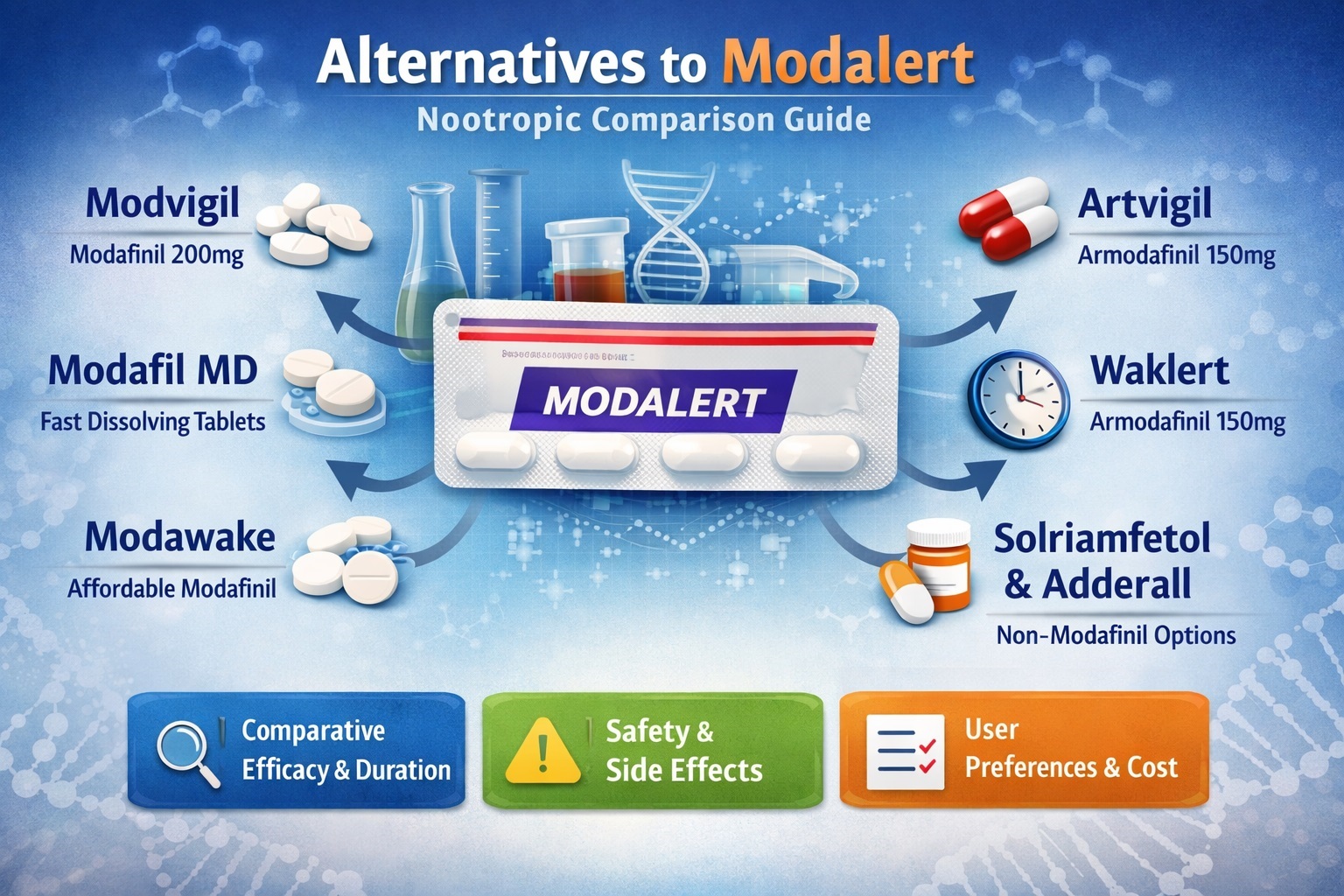
Some users find longer-lasting productivity benefits with armodafinil formulations like Waklert. A detailed pharmacological comparison is available in Modalert vs Waklert.
Armodafinil tends to maintain alertness later into the day, which may matter for extended work shifts.
Factors That Influence Productivity Outcomes
Dosage and Timing
Modalert is commonly used in 100–200 mg doses. Higher doses do not necessarily increase productivity and may increase side effects such as anxiety or insomnia.
Timing also matters. Taking Modalert too late in the day may impair sleep, indirectly reducing productivity over time.
Individual Neurochemistry
Not everyone responds the same way. Genetic differences in dopamine transporters and liver enzyme metabolism influence both effectiveness and tolerability.
This variability explains why some people consider Modalert highly effective while others see minimal benefit.
Reliability and Consistency Concerns
A common question is whether Modalert delivers consistent effects across batches and suppliers. Discussions around Modalert reliable focus on manufacturing standards rather than differences in the active compound.
Modalert is produced by Sun Pharma, a company with established pharmaceutical manufacturing practices, which contributes to consistency in dosing and formulation.
Productivity vs Wakefulness: An Important Distinction
It is important to separate wakefulness from productivity. Modalert reliably increases alertness, but productivity gains depend on:
- Task structure
- Work environment
- Baseline fatigue
- Self-discipline and planning
In clinical settings, modafinil is viewed as a performance stabilizer, not a productivity shortcut.
Safety Considerations for Long-Term Use
Long-term safety data suggest that modafinil is generally well tolerated when used responsibly, though side effects such as headaches, appetite suppression, and sleep disruption can occur.
The European Medicines Agency provides a comprehensive safety assessment here:
https://www.ema.europa.eu/en/documents/assessment-report/modafinil-epar-assessment-report_en.pdf
Regular medical oversight is recommended, especially for individuals using Modalert frequently for productivity purposes.
Final Evidence-Based Verdict
Does Modalert really boost productivity?
Yes—but conditionally.
Modalert appears most effective at preserving productivity under fatigue, sleep deprivation, or high cognitive load. It does not reliably increase creativity, motivation, or intelligence, and it is not a substitute for sleep or structured work habits.
In medical terms, Modalert enhances functional endurance, not superhuman performance.
Medical Disclaimer
This content is for educational purposes only and does not constitute medical advice. Always consult a licensed healthcare professional before using prescription medications.